


How the pictures are drawn.
Every star on SetuHQ is drawn in its blackbody colour from its stored temperature. Every planet is an artist's impression: its look is chosen from two measured things, its radius (or, without one, its mass) and the light it gets from its star. Nothing in a picture is measured beyond those numbers, and composition never is.
The rules
Composition, from the radius in Earth radii (1 RJ = 11.209 R⊕):
| Drawn as | Radius | Why |
|---|---|---|
| rock | below 1.6 R⊕ | Rogers 2015, ApJ 801, 41: most planets larger than about 1.6 R⊕ are not rocky |
| envelope | below 4 R⊕ | the radius valley at 1.5–2.0 R⊕ (Fulton et al. 2017, AJ 154, 109); sub-Neptunes up to 4 R⊕ |
| neptune | below 10 R⊕ | the catalogue's size-class boundary (Neptune-like 4–10 R⊕) |
| giant | 10 R⊕ or more | the catalogue's size-class boundary (gas giant 10 R⊕ or more) |
Without a radius, from the mass (or m sin i, a minimum mass) in Earth masses; such a planet is drawn at a fixed size, marked not to scale. With neither, no planet is drawn.
| Drawn as | Mass | Why |
|---|---|---|
| rock | below 2 M⊕ | below 2 M⊕ |
| ambiguous | below 10 M⊕ | 2–10 M⊕: rock or envelope, not decidable from mass |
| neptune | below 50 M⊕ | 10–50 M⊕ |
| giant | 50 M⊕ or more | 50 M⊕ or more |
Temperature band, from the equilibrium temperature Teq = 278.3 K × S1/4, where S = R★² (Teff / 5,772 K)⁴ / a² is the light the planet gets relative to Earth (zero albedo, full redistribution). Without a, a comes from Kepler's third law; without R★ or Teff, the catalogue's stored Teq is used; without that, the colours are neutral.
| Band | Teq | Why |
|---|---|---|
| cold | below 200 K | water ice is stable at the surface |
| temperate | below 350 K | spans the conservative habitable-zone fluxes; named temperate, not habitable |
| warm | below 1,000 K | between temperate and hot |
| hot | below 2,000 K | the substellar point reaches √2·Teq ≥ 1,414 K, about the basalt solidus; hot Jupiters are conventionally ≥ 1,000 K |
| ultrahot | 2,000 K or more | ultra-hot Jupiters (Parmentier et al. 2018, A&A 617, A110) |
A star's colour: a Planck spectrum from 380 to 780 nm, through the CIE 1931 colour-matching functions (the multi-lobe fit of Wyman, Sloan and Shirley 2013), to sRGB, normalised so the colour is a hue, not a brightness. Limb darkening is the quadratic law with Claret's (2017) TESS-band coefficients, applied to a visible disc. Granulation and planet surfaces are texture only: decorative, never data.
The 18 looks
Each look as its still (seed 1). Oceans and continents are drawn only for Earth itself, the Solar System reference; no exoplanet is given water.
- Artist's impression
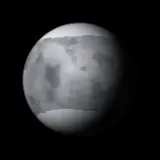
rock-coldrock · cold
pale grey rock, ice caps to latitude 40°, no atmosphere - Artist's impression
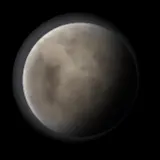
rock-temperaterock · temperate
grey-brown rock and a thin neutral rim; no oceans, continents or clouds - Artist's impression
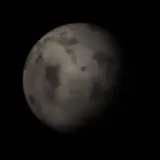
rock-warmrock · warm
bare dark rock with craters, no rim - Artist's impression
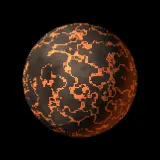
rock-hotrock · hot, ultrahot
dark rock with glowing day-side cracks - Artist's impression
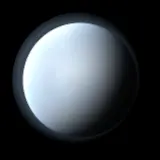
envelope-coolenvelope · cold, temperate
pale blue-white haze, faint bands - Artist's impression
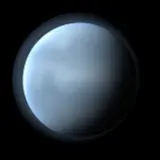
envelope-warmenvelope · warm
blue-grey haze - Artist's impression
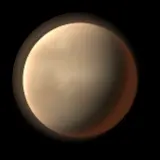
envelope-hotenvelope · hot, ultrahot
tan haze and a warm rim - Artist's impression
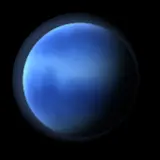
neptune-coolneptune · cold, temperate
deep blue bands and a dark spot - Artist's impression
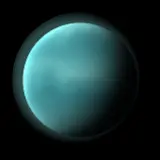
neptune-warmneptune · warm
teal haze - Artist's impression
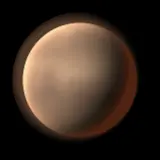
neptune-hotneptune · hot, ultrahot
orange-grey haze - Artist's impression
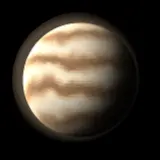
giant-coolgiant · cold, temperate
cream and tan cloud bands - Artist's impression
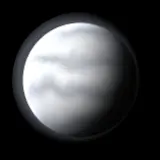
giant-warmgiant · warm
white cloud bands - Artist's impression
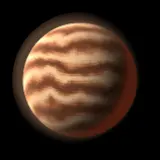
giant-hotgiant · hot
rust cloud bands - Artist's impression
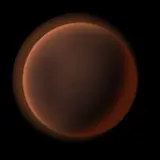
giant-ultrahotgiant · ultrahot
dark, low-contrast and glowing on the day side; no bands - Artist's impression
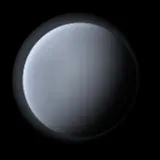
ambiguousambiguous · cold, temperate, warm, hot, ultrahot
a neutral grey-blue disc and a soft rim: rock or envelope, unknown - Illustration

ref-earthreference · Solar System reference
Earth, the Solar System reference: oceans, land and clouds - Illustration
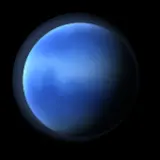
ref-neptunereference · Solar System reference
Neptune, the Solar System reference - Illustration
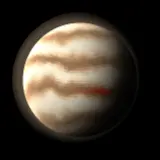
ref-jupiterreference · Solar System reference
Jupiter, the Solar System reference, with its Great Red Spot
The star and the transit
